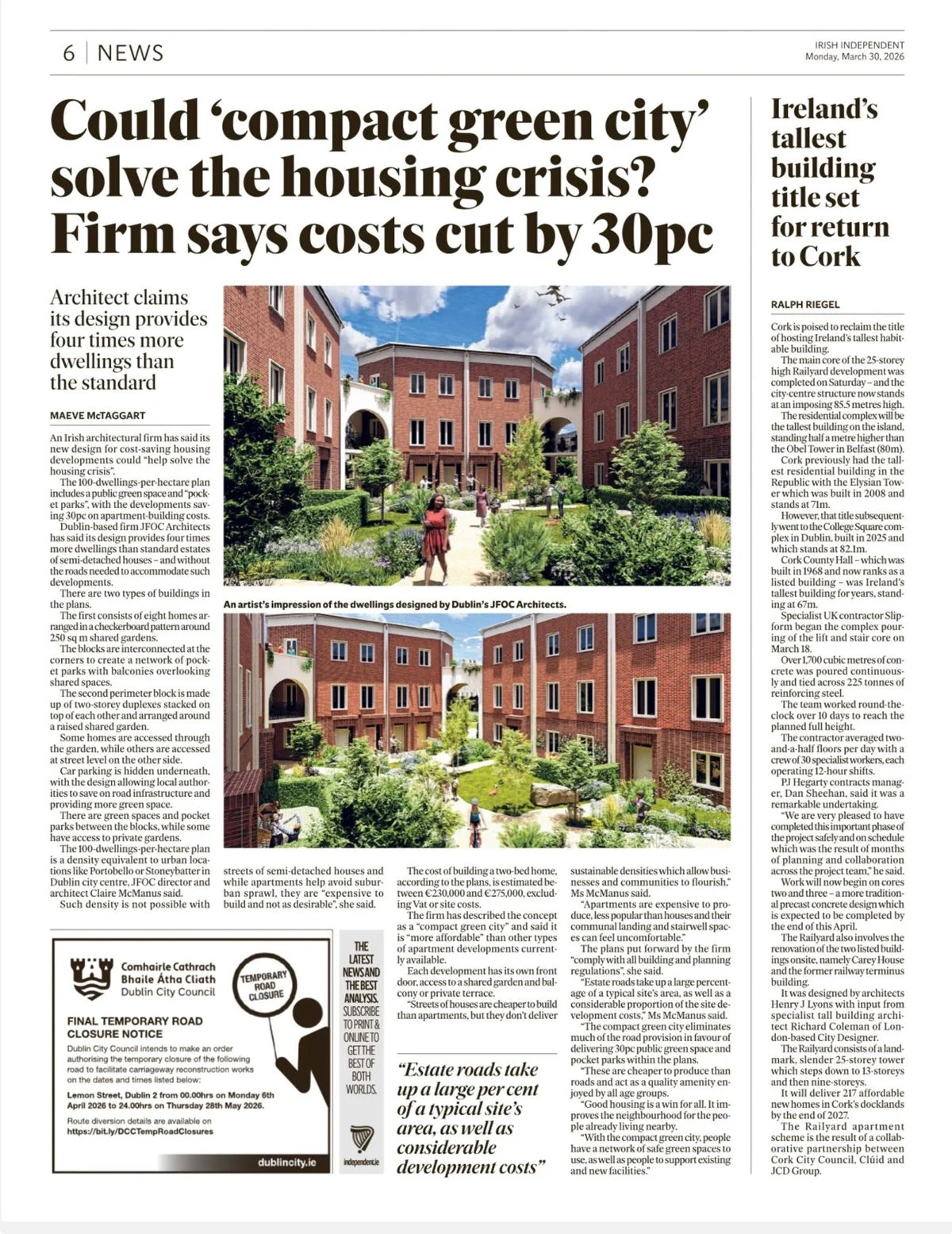
Could a “compact green city” solve the housing crisis?


An Irish architectural firm has launched designs for cost-saving homes and believes the concept could help address the issue.

An Irish architectural firm has said its new design for cost-saving housing developments could “help solve the housing crisis”. The 100-dwellings-per-hectare plan includes a public green space and “pocket parks”, with the developments saving 30% on apartment-building costs. Dublin-based firm JFOC Architects has said its design provides four times more dwellings than standard estates of semi-detached houses, without the extensive road networks typically required for such developments.

There are two types of buildings in the plans. The first consists of eight homes arranged in a checkerboard pattern around 250 sq m shared gardens. The cost of building a two-bedroom home is estimated between €230,000 and €275,000, excluding VAT and site costs. These blocks are interconnected at the corners to create a network of pocket parks, with balconies overlooking shared spaces. The second building type is a perimeter block made up of two-storey duplexes stacked on top of each other and arranged around a raised shared garden. Some homes are accessed through the garden, while others are accessed at street level on the opposite side. Car parking is hidden underneath, reducing the need for visible infrastructure and allowing more space for greenery.

Green spaces and pocket parks are integrated between the blocks, with some homes also benefiting from private gardens. The density of 100 dwellings per hectare is comparable to urban areas such as Portobello or Stoneybatter in Dublin city centre, according to JFOC director and architect Claire McManus. She noted that such density is not achievable with streets of semi-detached houses. While apartments can help prevent suburban sprawl, they are often expensive to build and less desirable for residents.

The firm has described the concept as a “compact green city” and says it is more affordable than current apartment developments. Each home has its own front door, access to a shared garden, and either a balcony or private terrace.

“Streets of houses are cheaper to build than apartments, but they don’t deliver sustainable densities which allow businesses and communities to flourish,” Ms McManus said. “Apartments are expensive to produce, less popular than houses, and their communal landing and stairwell spaces can feel uncomfortable.”

She added that the plans comply with all building and planning regulations. Estate roads, she explained, take up a large portion of a site’s area and development costs. The compact green city design reduces road provision, instead allocating 30% of the space to public green areas and pocket parks.

“These are cheaper to produce than roads and act as a quality amenity enjoyed by all age groups,” Ms McManus said. “Good housing is a win for all. It improves the neighbourhood for the people already living nearby. With the compact green city, people have a network of safe green spaces to use, as well as a community to support existing and new facilities.”